

Ramp Tech, established in 2014 and based in Vadodara, Gujarat, is a leading manufacturer and supplier of Plate Heat Exchangers (PHEs) and related components. The company specializes in providing high-quality PHEs, gaskets, plates, and spares compatible with all major brands, including Alfa Laval, Sondex (now Danfoss), Tranter, and Kelvion (now GEA Eco-flex) .
Price Range: 8,000 350,000 per piece
Structure: Plate Heat Exchanger
Temperature: High-temperature applications
Condition: New
Usage: Industrial
Features:
High thermal efficiency
Wide temperature and pressure resistance
Compact design with high turbulence for efficient heat transfer
Low hold-up volume
Vibration resistance
Price: 400,000 per piece
Structure: Plate Heat Exchanger
Temperature: High-temperature applications
Condition: New
Usage: Industrial
Features:
Withstands higher design pressures
Lightweight and compact
Flexible design suitable for various applications
Materials of Construction (MOC):
SS304, SS316L
SMO 254, 904L
Titanium
Hastelloy C-276, C-2000
Nickel-200/201
Ti-Pd
Function: Increase or decrease the heating surface area in PHEs
Materials of Construction (MOC):
NBR-HT, EPDM, EPDM-HT, CR, HNBR, FKM-A, G, S, PTFE Envelop
Function: Ensure leak-proof sealing and optimal performance
Maintenance & Refurbishment: Decommissioning, gasket removal, chemical cleaning, and reassembly of PHEs
Customization: Tailored solutions for specific applications, including customized gaskets and plates
24/7 Support: Round-the-clock service availability to minimize downtime
Ramp Techs PHEs and services cater to various industries, including:
Dairy and food processing
Pharmaceuticals
Chemicals
Power generation
HVAC systems
Oil & Gas
Marine
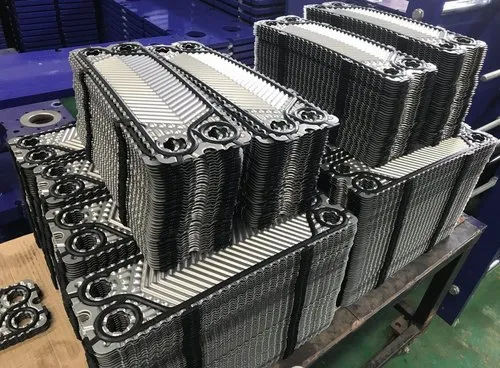

Price:
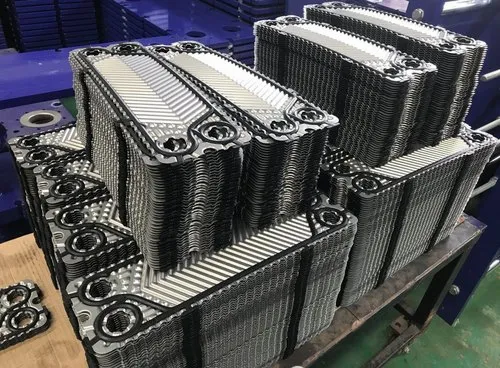
Price 1000 INR / Piece
Minimum Order Quantity : 10 Pieces
Condition : New
Structure : Plate Heat Exchanger
Temperature : Other, 30C to 350C operating range
Power : Not Applicable (passive heat exchanger)
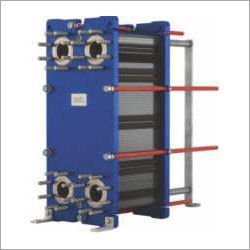
Price 25000.00 INR / Piece
Minimum Order Quantity : 1 Piece
Condition : New
Structure : Other, Frame & Plate, Gasketed
Power : N/A (Nonelectric equipment)
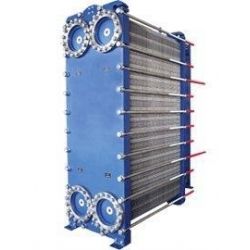
Price 400000.00 INR / Piece
Minimum Order Quantity : 1 Piece
Condition : New
Structure : Plate Heat Exchanger
Temperature : Hightemperature
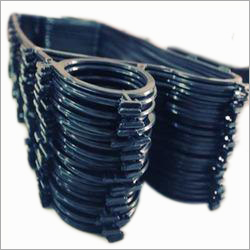
Price 1100.00 INR / Piece
Minimum Order Quantity : 1 Piece
Condition : New
Temperature : MediumTemperature
GST : 24AFMPC8831Q1ZX


 Send Inquiry

 Send Inquiry
 Send Inquiry
 Send SMS


